




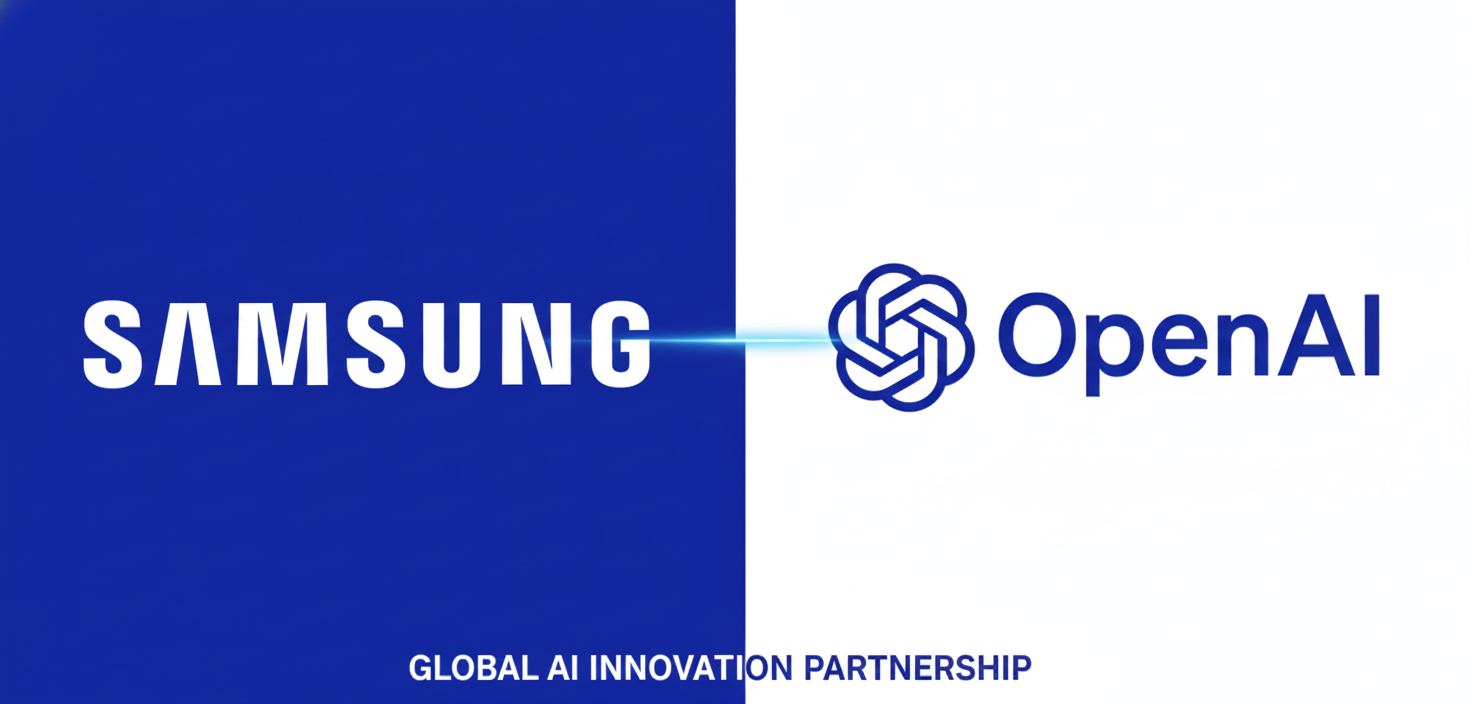
OpenAI has entered into a major strategic partnership with Samsung Electronics, joined by affiliated Samsung companies and SK Hynix, to secure advanced memory-chip supply and collaborate on building next-generation AI data centers. The agreement is part of OpenAI’s ambitious global AI-infrastructure initiative known as Stargate.
The deal was formalized through a Letter of Intent signed in Seoul after high-level discussions between OpenAI leadership, Samsung executives, and South Korea’s president. This collaboration positions Samsung and SK Hynix as core suppliers of memory technologies essential for powering future AI systems.
What the Agreement Covers
The new partnership lays the foundation for a broad hardware–infrastructure collaboration:
1. Massive memory-chip supply
Samsung and SK Hynix will provide advanced DRAM and high-bandwidth memory used in AI accelerators and large-scale compute clusters. OpenAI’s projected need is extremely high, up to 900,000 DRAM wafers per month, a scale that could represent nearly 40% of global DRAM output once fully ramped.
2. Joint development of global AI data centers
Samsung affiliates, including Samsung SDS, Samsung C&T, and Samsung Heavy Industries, are expected to collaborate on designing, constructing, and operating data-center facilities around the world. This extends the partnership far beyond chip supply, integrating infrastructure, engineering, and operations.
3. Long-term support for the Stargate initiative
The partnership aligns multiple South Korean technology leaders around OpenAI’s multi-year plan to build a robust, global AI-compute backbone capable of supporting increasingly large and complex models.
Why This Deal Matters
A. Unlocking massive AI compute capacity
Advanced memory, especially HBM, is one of the main bottlenecks in training and running large AI models. By securing a dedicated supply at unprecedented scale, OpenAI ensures stable access to the memory bandwidth needed for upcoming generations of AI systems.
This deal also marks a move from assembling compute resources piece-by-piece toward developing vertically integrated AI infrastructure: chips, data centers, supply chains, and operations working as a unified system.
B. Reshaping global semiconductor demand
The projected demand from Stargate is large enough to shift the entire memory-chip industry:
- Memory makers may prioritize AI infrastructure over consumer electronics.
- Supply shortages or price increases for PC, smartphone, and gaming memory could become more common.
- South Korea’s role in the global AI hardware ecosystem strengthens significantly as its leading chipmakers become essential to the AI boom.
C. Accelerating global AI-data-center expansion
Beyond chips, the partnership hints at new data-center facilities possibly being built in South Korea and other regions. Samsung’s capabilities in construction, logistics, and heavy industry could enable innovative approaches, including large-scale or even offshore data-center concepts.
This represents a shift from cloud-provider dependence toward highly specialized AI-specific infrastructure built for extreme power and memory needs.
Open Questions and Industry Implications
Despite the LOI, several details are still evolving:
- OpenAI has not specified when production would reach the targeted 900,000 wafers per month.
- The division of responsibilities across wafer fabrication, packaging, and final memory-module production remains unclear.
- The impact on consumer-device markets depends on how quickly manufacturers increase overall production capacity.
What is clear is that the semiconductor industry is entering a new era where AI infrastructure, not smartphones or PCs, is driving the largest and most strategic investments.
A Turning Point for AI and Hardware
This partnership marks one of the most significant industrial commitments in the AI age. By securing massive volumes of memory and collaborating across infrastructure, engineering, and data-center operations, OpenAI is setting the stage for an integrated global compute platform.
For Samsung and SK Hynix, the deal signals a bet on AI becoming the dominant force in the semiconductor market, with memory demand driven not by consumer devices but by AI supercomputing at global scale.
For the broader market, the ripple effects could reshape pricing, supply chains, and investment priorities for years to come.
Conclusion
The collaboration among OpenAI, Samsung, and SK Hynix represents a foundational milestone in the evolution of global AI infrastructure. It underscores how AI is no longer just a software challenge, it is becoming a massive industrial endeavor involving chips, data centers, supply chains, and national-level coordination.
As Stargate advances, this partnership could play a central role in powering the next generation of AI capabilities, reshaping both the semiconductor landscape and the global tech economy.