

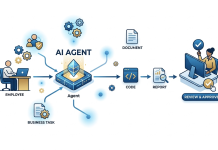




For the past few years, enterprise AI has largely lived in pilot programs, isolated experiments testing what generative models could do for a single team or use case. That phase is ending. Organizations across industries are now moving past proof-of-concept work and building AI agents directly into how their businesses operate.
From Isolated Tasks to Autonomous Workflows
Traditional enterprise AI tools were built to handle one task at a time: draft an email, summarize a document, answer a customer query. AI agents represent a different model entirely. Rather than performing a single function, they can carry out multi-step processes with little to no human coordination, for example, receiving a customer complaint, checking account history, reviewing the relevant policy, drafting a resolution, and routing it for final approval.
This shift from task automation to process autonomy is what separates agentic AI from earlier generations of enterprise tools. It’s also why so many technology leaders view 2026 as an inflection point. Industry researchers project that a substantial share of enterprise applications will include task-specific AI agents by the end of the year, a dramatic jump from just a few years ago.
Adoption Is Broad, but Deployment Is Uneven
Despite the momentum, there’s an important distinction between organizations experimenting with AI agents and those actually running them at scale. Multiple industry surveys point to the same pattern: a large majority of enterprises report using AI in at least one business function, yet only a modest fraction have moved agentic AI from pilot to full production.
The gap comes down to more than technical readiness. Companies that have successfully scaled AI agents tend to share a few traits: they select measurable, well-defined business problems, build governance and monitoring into the system from the start, and expand gradually only after proving results. Businesses that stall out, by contrast, often treat AI agents as a bolt-on feature rather than a core part of how a workflow is designed.
Adoption also varies significantly by industry. Sectors with strong governance infrastructure and clear regulatory frameworks, banking, insurance, and financial services among them, tend to lead in genuine production deployment. Fields like healthcare and government, where compliance and risk tolerance are more complex, have generally moved more cautiously.
Why the Shift Is Happening Now
Several converging factors are pushing enterprises to move beyond experimentation:
1. Budget discipline is replacing open-ended spending. The earlier wave of AI investment funded a wide range of pilots based on enthusiasm alone. That approach is giving way to more targeted spending, concentrated in projects that have already demonstrated measurable value. Analysts expect a meaningful share of unfocused pilots to be discontinued as budgets tighten around what works.
2. Governance structures are maturing.A growing number of organizations have created dedicated roles, often titled “AI agent owner” or “agentic operations lead,” to oversee how they deploy, monitor, and audit AI agents. This kind of structured ownership correlates strongly with organizations that successfully reach production.
3. The technology itself is becoming more coordinated. Multi-agent systems, in which several specialized agents collaborate on a single workflow, are becoming more common in production environments. Supporting infrastructure, including open standards for connecting agents across different vendors and platforms, is also expanding rapidly.
4. Return on investment is becoming measurable. Enterprises are increasingly able to track time-to-value for agent deployments, with some functions, like sales development, seeing payback within a few months. That kind of concrete evidence is what’s convincing leadership teams to move from cautious testing to committed rollout.
What This Means for Business Leaders
For organizations still in the experimentation phase, the message from 2026 is clear: the technology question is largely settled. AI agents are capable of handling meaningful, bounded work reliably. The real challenge is organizational, building the governance, measurement, and operational ownership needed to deploy agents responsibly at scale.
Leaders considering their next steps should focus on a few practical priorities. Start with a specific, high-volume workflow where success can be clearly measured rather than attempting a broad rollout. Establish clear ownership and monitoring before scaling, not after. And treat the shift to agentic AI as a redesign of how work gets done, not simply a new tool layered onto existing processes.
Conclusion
The transition from experimentation to enterprise-wide AI agents won’t happen uniformly across every company or industry. But the direction of travel is unmistakable. As governance models mature and more organizations demonstrate measurable returns, the businesses that treat this moment as a strategic shift, rather than another tech trial, will be the ones positioned to benefit most.