



For the past few years, most companies have used AI as a smart assistant: ask a question, read the answer, get back to work. That is changing. New research from OpenAI suggests the most advanced organizations now hand AI entire tasks and simply review the results. The gap between those firms and everyone else is widening quickly.
From Answering to Doing
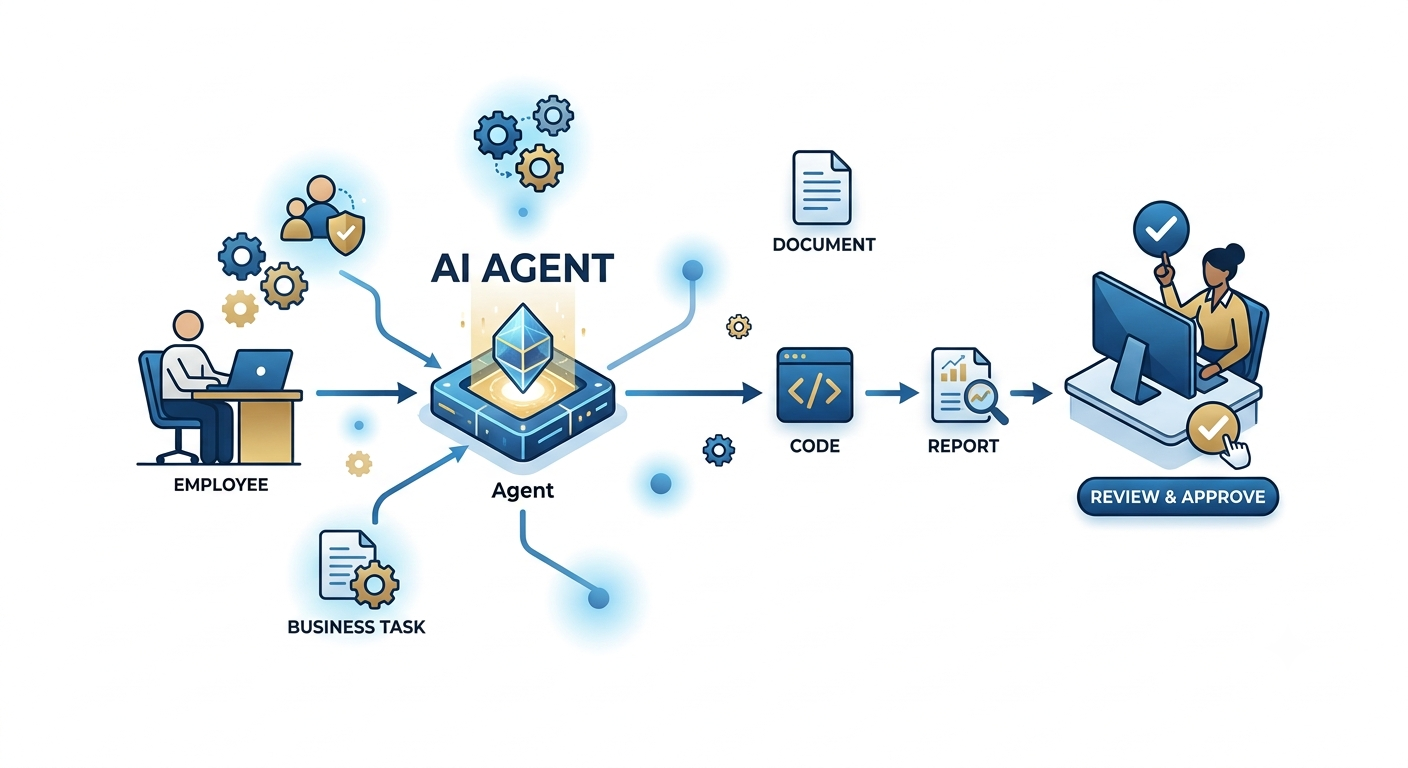
An assistant can explain how to put together a presentation. An agent gathers the material from several sources, builds the deck, and returns it for your sign-off. That difference is starting to show up in usage data.
By June 2026, Codex, OpenAI’s agentic tool, accounted for 64% of the output tokens that enterprise customers generated across Codex and ChatGPT combined. Part of that share reflects the nature of agents: they run longer, multi-step jobs that naturally produce more output. So the figure captures both how often agents are used and how big the tasks are.
The Frontier Gap Is Growing
OpenAI ranks its enterprise customers each month by output tokens per active user. The top 10% are labeled “frontier” firms, while typical firms sit near the middle of the pack.
In January, frontier firms produced about 2.6 times as much output per user as typical firms. By June, that multiple had reached 8.3. The pattern isn’t confined to tech companies; it appears across industries and company sizes.
The companion working paper looked at U.S. public companies and found that enterprise adopters tended to be larger, employ more people, and spend more on R&D than non-adopters. The takeaway is that buying access to a model isn’t enough. Firms that pull ahead also invest in training, shared workflows, data infrastructure, and governance.
What Frontier Firms Do Differently
Agents are only as useful as the context and tools they can reach. Frontier firms are more likely to use features that supply both.
Plugins are the clearest example. They bundle skills, which are reusable instructions, with apps that connect to company data and systems. A sales plugin, for instance, might combine a team’s playbook with its CRM, so an agent can draft a tailored proposal using current customer details and past deals.
Weekly usage shows the divide:
- Plugins: 21% of active users at frontier firms versus 9% at typical firms
- Skills: 19% versus 3%
Even frontier firms have room to grow. At OpenAI itself, 95% of active employees use Plugins every week.
Agents Are Leaving the Engineering Team
Software development was the first home for agentic AI, but it is no longer the fastest-growing one. Since February, weekly enterprise Codex users have grown 108-fold in legal, 41-fold in sales and in recruiting, and 26-fold in marketing, compared with 5-fold in engineering. Those jumps start from small bases, but the direction is clear.
Virgin Atlantic offers a snapshot. Its engineers used Codex to refactor legacy code in 30 minutes rather than two weeks, and its product teams compressed weeks of competitive research into hours, informing a five-year digital strategy.
Junior Employees Are Leading the Way
Many surveys suggest executives are the heaviest AI users. OpenAI’s administrative data, drawn from millions of conversations, points the other way. Six months after adoption, early-career employees were sending 13 more messages per week than executives.
For leaders, that is an opportunity. The people with the strongest AI habits may be several levels below them. Finding those employees and making their workflows visible is a practical way to spread good practice.
How Leaders Can Close the Gap
Most companies have access to the same models, so the difference comes down to execution. The research points to three priorities:
- Connect agents to real context. Give them access to the data, tools, and playbooks that valuable work depends on.
- Set the guardrails. Define permissions, review steps, and governance so people can trust agent output.
- Turn personal wins into shared practice. Package effective individual workflows so entire teams can use them.
It also helps to look beyond engineering. Legal, sales, recruiting, and marketing teams are adopting agents quickly, and they often have repetitive, document-heavy work well suited to delegation.
A Note of Caution
This research comes from OpenAI and describes OpenAI’s own customers, so it reflects one vendor’s view of the market. Output tokens are also a proxy for depth of use, not a measure of business value. A firm can generate a great deal of output without improving results. Leaders should pair usage numbers with outcomes such as time saved, quality, and cost.
Conclusion
Enterprise AI is shifting from helping people think to helping them finish. The firms moving fastest are connecting agents to their data, putting governance in place, and sharing what works across teams. For everyone else, the gap is still closable, but the data suggests it is getting wider each month.